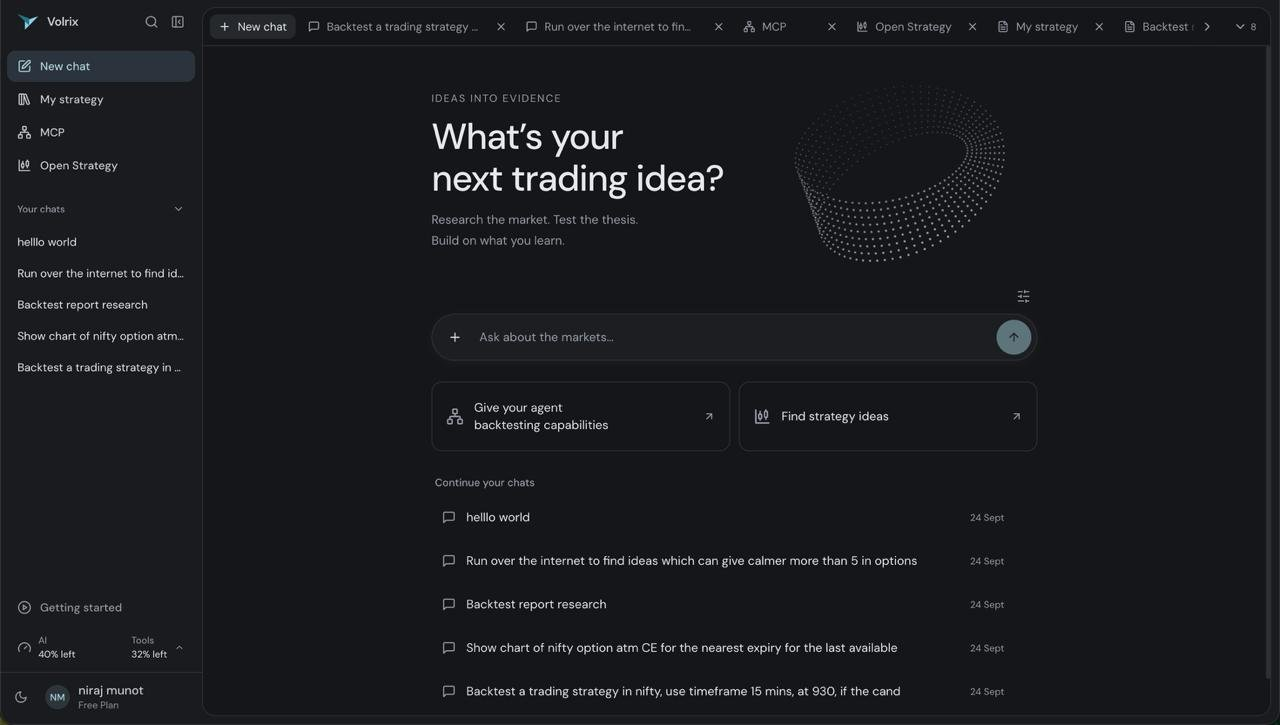
A trading idea can begin with a message, a YouTube video, a Reddit discussion, or a question about the market. Turning it into something testable usually takes several steps: research the idea, define the rules, run a backtest, and understand the results.
Volrix Chat brings that workflow into one conversation. You can research ideas, build strategies, explore charts, save your work, and run portfolio backtests directly inside Volrix.
Here is what you can do.
1. Start with a message
Describe your idea in plain language. You can bring a complete strategy or start with a rough outline and work through it with the assistant.
Specify the market, entry conditions, exits, position size, and period you want to test. Volrix can help turn those instructions into strategy code, identify missing rules, and explain the assumptions used.
Help me turn my NIFTY entry and exit rules into a strategy. Check what information is missing before we backtest it.
The conversation stays connected, so you can refine the idea through follow-up messages.
2. Run backtests and understand the results
Once the rules are defined, ask Volrix to run the backtest. You can review the report and keep asking questions in the same chat.
Explore returns, drawdowns, trade outcomes, and the effect of execution costs. Change a rule, test another period, or compare a variation with the original.
Backtest the strategy we just defined. Include transaction costs, state the slippage assumption, and explain its largest drawdown.
Keep dates, capital, sizing, and costs clear when comparing results. A useful comparison starts with knowing what changed between runs.
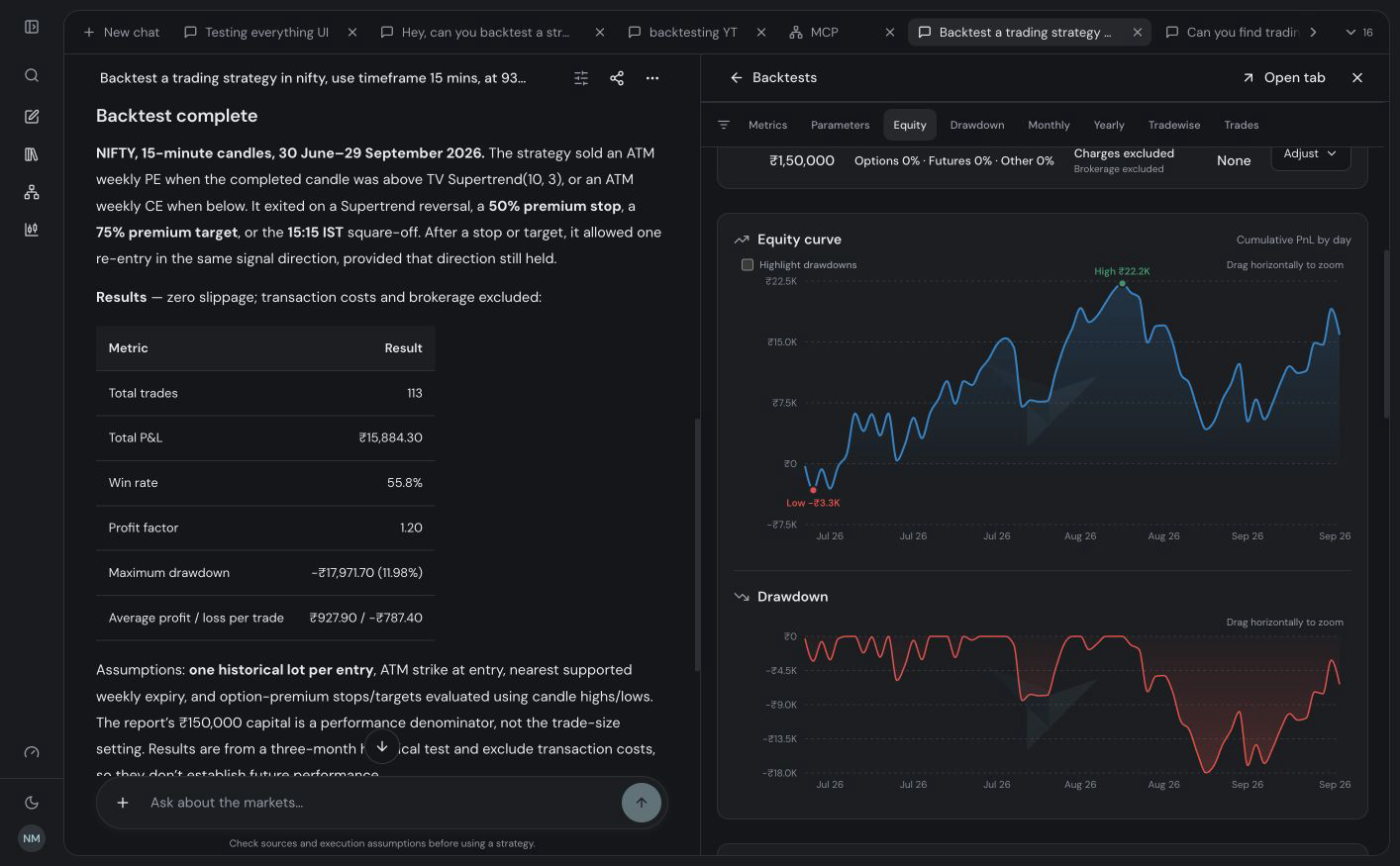
Review the equity curve and drawdown beside the conversation.
3. Build and test market hypotheses
You do not need a trading strategy to begin researching. Start with a question about historical market behavior, then turn the findings into a hypothesis you can test.
For example, you might investigate option premiums at a particular time, compare behavior across expiry conditions, or examine how an indicator relates to later price movements.
For NIFTY expiry days in the last four months, study the ATM call and put premiums at 09:30. Show the distribution, sample count, and any missing observations.
You can investigate the data first and define trading rules afterward. Ask what evidence supports the hypothesis, what contradicts it, and what further test would be useful.
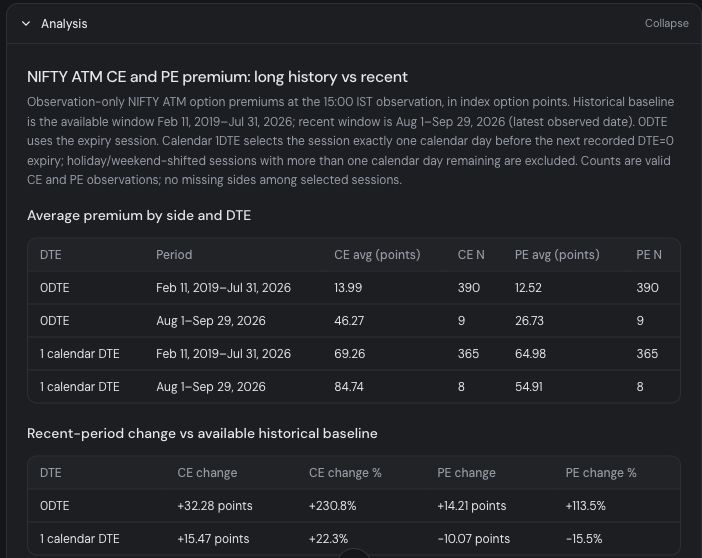
Compare ATM call and put premiums across historical periods.
4. Understand strategies from YouTube videos
Paste a YouTube link and ask Volrix to explain the strategy discussed in it. The assistant can use available captions or an audio transcript to extract the spoken entry, exit, sizing, and risk rules.
Explain the strategy in this video. List its exact rules, highlight anything the speaker leaves unspecified, and help me prepare a backtest.
Details shown only on screen may need clarification. Volrix works from the available transcript, so it should identify gaps before turning the explanation into executable rules.
From there, continue in the same chat to test the interpretation and examine its results.
5. Research Reddit discussions and the wider web
Ask Volrix to search public sources for strategy ideas, explanations, and competing views. That includes publicly accessible Reddit discussions and relevant pages across the web.
Use the conversation to compare approaches, find their assumptions, and turn a broad discussion into a focused research question.
Find public Reddit discussions and web sources about opening-range strategies. Link the sources, summarize the proposed rules, and identify which claims we can test.
Source links help you trace an idea back to its context. Historical tests use Volrix market data; the articles and discussions provide ideas and explanations to investigate.
6. Show charts and explore the data
You can ask for supported market charts and indicators, or request charts, tables, and metrics based on research and backtest results.
Show the latest available NIFTY one-minute chart with RSI and explain what the indicator is measuring.
Follow up with a more specific question: compare periods, plot a distribution, inspect an equity curve, or ask for a table of strategy results. Charts and reports appear inside the workspace, keeping the visual evidence close to the conversation.
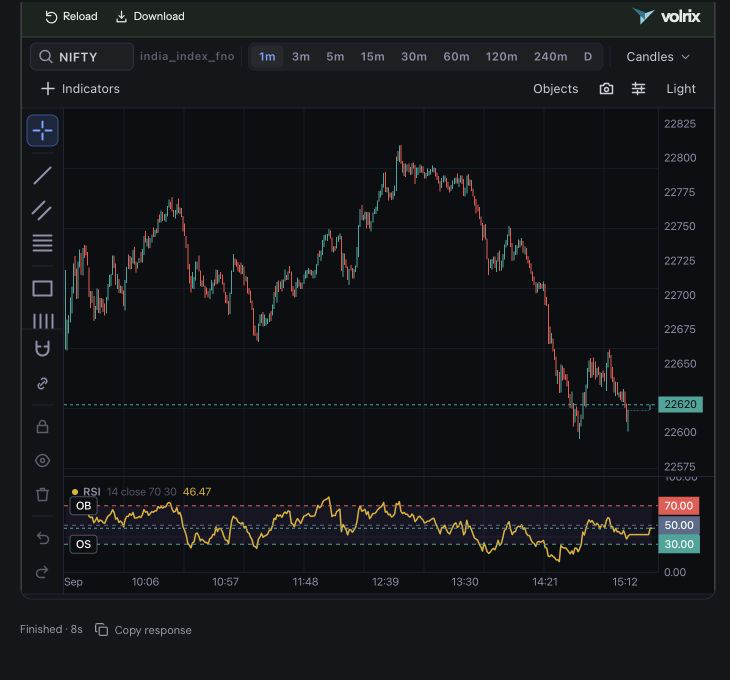
Explore NIFTY candles and RSI inside the chat.
7. Save strategies and reuse them
When you want to keep a strategy, ask Volrix to save it to My strategy. Saved strategies retain their code and settings so you can return to them in another chat.
Organize related strategies into folders and use them as the starting point for later research.
Save this strategy to my opening-range folder. In a new chat, help me test it over another available period.
This makes it easier to build a research library and revisit the actual rules you tested.
8. Run portfolio backtests directly from chat
You can ask Volrix to backtest strategies from a saved folder, review each member's result, and compare compatible runs as a portfolio.
Backtest all the strategies from Folder "X". Show portfolio MTM and each underlying's trades.
Start your next research conversation
Open Volrix Chat, describe your idea, and build on what you learn. Start with a market question, a strategy, or a source you want to understand.
Volrix Chat is available exclusively on the MAX plan. If you already use MAX, sign in and start chatting.
New users can get 50% off their first month of MAX with code VOLMAX50. Get MAX with the offer.